

Assessment is one of the most influential components of higher education. It shapes how students learn, how faculty teach, and how institutions judge academic quality. As learning environments evolve, assessment practices must evolve as well.
Written examinations and objective tests continue to serve an important role. However, they offer limited insight into how students reason, explain, or apply knowledge. In an environment where content is increasingly accessible, institutions must find ways to assess understanding rather than reproduction.
Video assessments represent one such shift.
Why Traditional Evaluation Faces New Limits
Traditional assessments were designed for a context where access to information was limited and learning took place largely within the classroom. Today, students have access to abundant resources, tools, and generative technologies.
This has introduced challenges that institutions now face:
- Difficulty distinguishing genuine understanding from reproduced responses
- Limited visibility into a student’s reasoning process
- Increased time spent reviewing written submissions without corresponding insight
These challenges are not failures of faculty or students. They reflect a mismatch between traditional assessment formats and modern learning contexts.
Assessment Through Explanation
Explaining a concept requires a different level of engagement than writing an answer. When students articulate an idea in their own words, they must organise their thoughts, connect concepts, and demonstrate clarity of understanding.
Video assessments place emphasis on explanation rather than output. They allow institutions to evaluate:
- Conceptual clarity
- Logical reasoning
- Ability to apply knowledge
- Communication and articulation
This makes learning visible in ways that written responses often cannot.
Integrating Video Assessments into Academic Practice
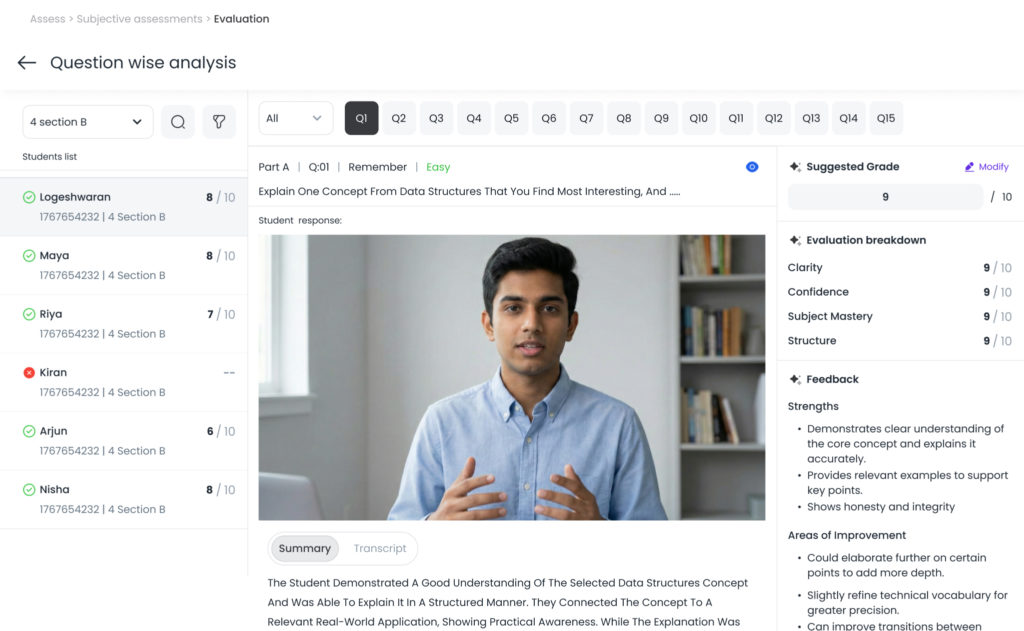
Video assessments are most effective when they are structured and aligned with academic intent. Within Intelligent Learning Infrastructure, they are not treated as informal recordings, but as guided academic activities.
Faculty/ILI define questions aligned to learning outcomes. Students respond within defined parameters. Evaluation follows structured rubrics that focus on understanding and reasoning.
This approach ensures that assessment remains rigorous, fair, and academically grounded.
Maintaining Academic Control and Consistency
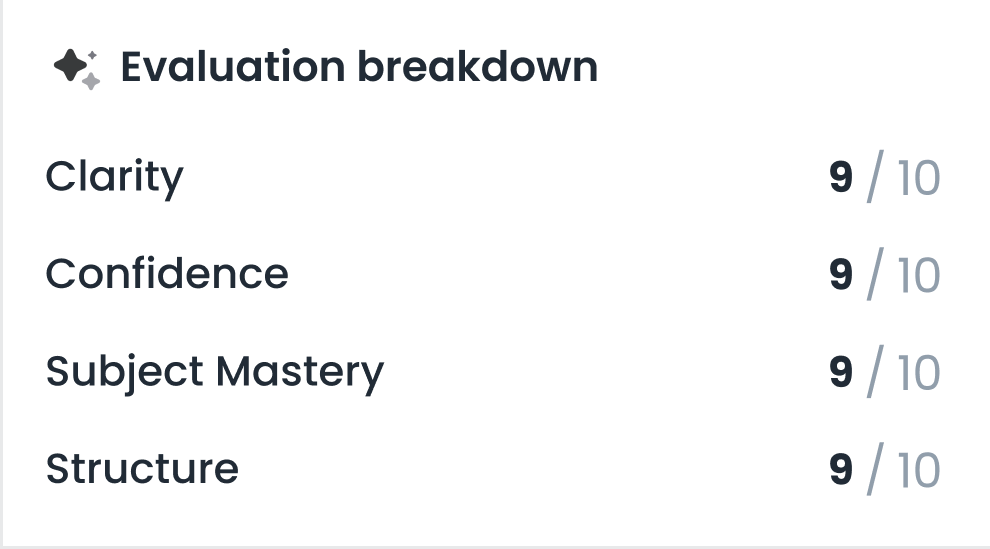
A common concern with alternative assessment formats is consistency. Video assessments address this through a customised rubric-driven evaluation.
Rubrics provide:
- Clear evaluation criteria
- Consistency across sections and cohorts
- Transparency for students
- A shared academic framework for faculty
Faculty retain full control over evaluation. They can review, adjust, and contextualise assessments while benefiting from structured support.
Institutional Perspective
From an institutional standpoint, video assessments offer several advantages.
They provide stronger evidence of learning quality, particularly for higher-order learning outcomes. They support outcome-based education by linking assessment directly to explanation and reasoning. They also offer defensible evidence during academic reviews and accreditation processes.
Most importantly, they shift assessment from a record-keeping exercise to a source of academic insight.
Assessment as a Learning Process
Video assessments also change the role of feedback. When students receive rubric-based insights on how they explain and reason, evaluation becomes part of the learning process rather than a terminal event.
This supports reflection, improvement, and deeper engagement with subject matter.
Looking Ahead
Video assessments do not replace traditional methods. They complement them where depth of understanding matters.
As institutions rethink how learning is evaluated, approaches that reveal understanding rather than submission will play a central role. Video assessments represent a practical step in that direction—grounded in academic intent and aligned with the realities of modern learning.