

It’s 11 PM on a Wednesday. You’ve just finished grading 120 assessment papers. Your eyes hurt from staring at calculations, your back aches from hunching over the desk, and you still need to enter scores into three different systems before tomorrow’s class. You know Priya needs help. She’s close to understanding thermodynamic cycles but keeps making the same conceptual error; Ravi’s confidence is shot after two failed assessments, even though his reasoning is actually getting stronger; and Anjali is coasting on memorization and will hit a wall when complexity increases in the next module. You know all this. But it’s 11 PM, you have an 8 AM class tomorrow, and you haven’t even looked at the data to see what patterns emerged from today’s assessment. The conversation with Priya that could change her trajectory? It will have to wait. Maybe next week. Maybe never.
Most learning analytics platforms give you data but not direction. AI-powered learning analytics can change that by translating raw numbers into actionable insights. Instead of spending hours decoding dashboards, faculty receive clear guidance on which students need what help and why. According to research from the American Association of University Professors, faculty spend up to 60% of their time on administrative tasks rather than teaching. Learning analytics should reduce that burden, not add to it.
The Feedback Gap and How to Solve It
Ask any engineering student what feedback helps them improve, and they’ll tell you: not just a score, but where exactly their understanding broke down and what to practice next. Ask any faculty what feedback they wish they could give, and they’ll describe exactly that: personalized guidance, specific next steps; the kind of insight that comes from really understanding where each student is stuck.
The gap isn’t about caring or expertise. It’s about time that doesn’t exist. You’re managing 300 students across three courses. Each assessment generates data: who scored what on which topics, time spent, problem types, and historical comparisons. All potentially useful; none actionable unless someone has three hours to analyze patterns, cross-reference metrics, and identify who needs what specific help.
By the time you could do that analysis, students have moved on. The intervention moment is gone.
Why Most LMS Analytics Fail Faculty
Your learning management system probably gives you analytics: Graphs, tables, and distributions. All accurate; all passive. They show you what happened, but not what to do about it. You log in, see the numbers, and still face the same question: now what?
Most analytics platforms stop at observation. They don’t translate data into action plans. Faculty are left to bridge that gap themselves, and there simply isn’t time. Edwisely ILI solves these problems.
How AI-Powered Learning Analytics Actually Help
The bottleneck isn’t teaching expertise. It’s that teachers are spending hours on pattern recognition work that computers handle in seconds.
After an assessment, what takes time is identifying which topics most students struggled with, spotting unusual performance patterns, comparing cohorts, processing distributions, and synthesizing data points into insights. This is exactly what AI excels at.
Meanwhile, faculty who understand teaching, students, and context spend evenings doing work a machine could finish instantly. What if AI handled the pattern recognition so you could handle the teaching decisions? Not AI making pedagogical choices, but doing what computers do well (processing data at scale, identifying patterns) so teachers do what only teachers can do (understanding context, making judgment calls, designing learning experiences, building relationships).
AI can spot that 67% of students failed questions about applying concepts to unfamiliar scenarios. It can flag two students who aced complex questions but failed basic recall. It can identify twelve students who demonstrate strong reasoning but make calculation errors. But AI cannot decide that the festival week disrupted teaching, so you should schedule a review session. It cannot know whether flagged students had answer keys or test anxiety. It cannot determine that those twelve students need calculation practice paired with peer support.
That’s where you come in. The expertise. The context. The human judgment.
From Passive Data to Active Guidance with AI-Powered Learning Analytics
Some institutions are already implementing this collaboration model, and it looks fundamentally different.
Walk into certain AI-powered campuses using Edwisely, and you’ll see something unusual: wall-mounted dashboards displaying real-time learning patterns. Not hidden in faculty-only logins, but visible in shared spaces where teaching happens.
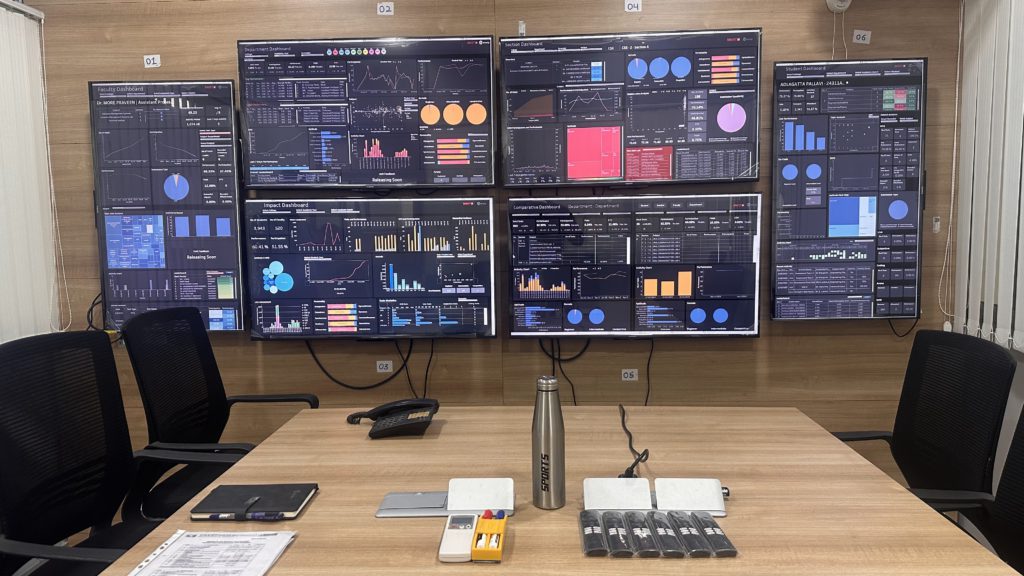
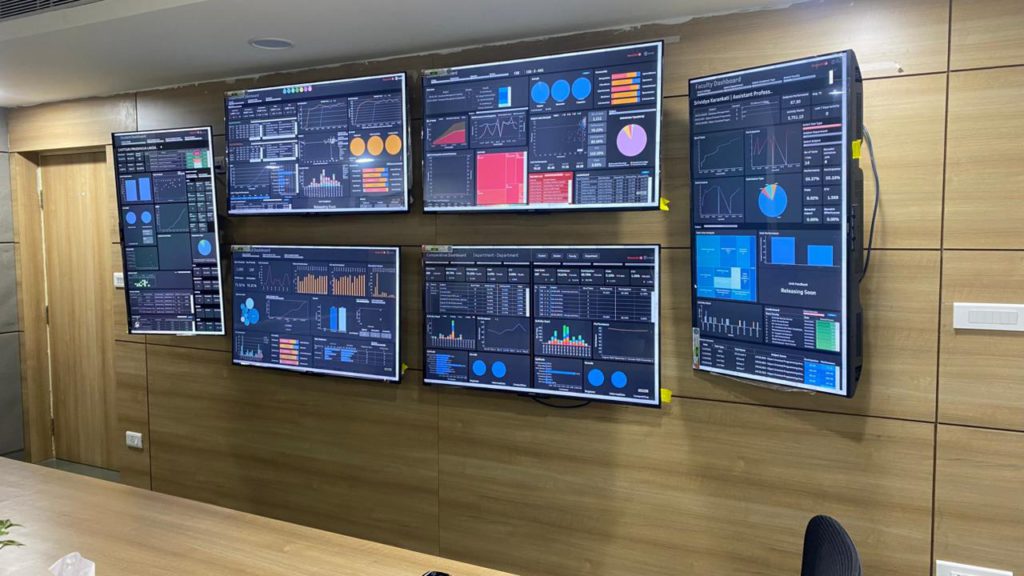
These aren’t decorative. When data is public and accessible, conversations happen naturally. Faculty discuss patterns during breaks. Students see their collective learning journey. The culture shifts from data as judgment to data as an improvement tool.
But visibility alone doesn’t solve the action gap. The breakthrough is what faculty receive after assessments: not just graphs, but translation.
You open the platform and see class-level SWOC analysis:
Three things need your attention:
- Strength: Half the class shows basic understanding, creating a foundation to build on. Students who attempted showed high engagement.
- Weakness: Only 3% participation rate. Half the class performed below 35%, indicating significant comprehension gaps.
- Opportunity: Increase participation through engaging activities and targeted intervention for the bottom 50%.
- Challenge: Extremely low participation undermines data reliability. A wide performance gap requires differentiated instruction.
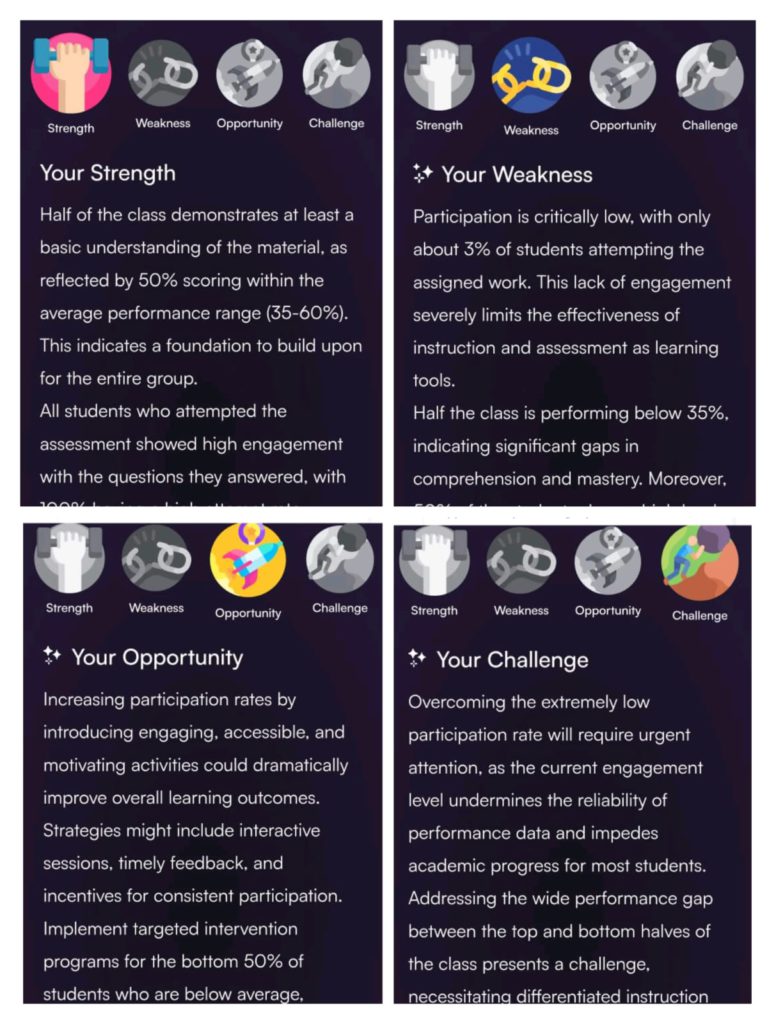
Three minutes to read. You immediately know that participation is the crisis, half the class has a foundation to build on, and you need differentiated strategies.
Meanwhile, each student gets their personalized analysis:
- Strengths: High attempt rate (83%) shows strong engagement. Excellent performance on prioritizing information (100% on one topic).
- Weakness: Overall low performance (16.67%) with gaps in foundational concepts. High fluke rate suggests guesswork rather than understanding.
- Opportunity: Leverage your strength in organizational thinking to improve related topics. Move beyond recall to a deeper understanding.
- Challenge: Convert effort into actual learning. Reduce guesswork, develop better test-taking strategies, and focus on specific weak topics.
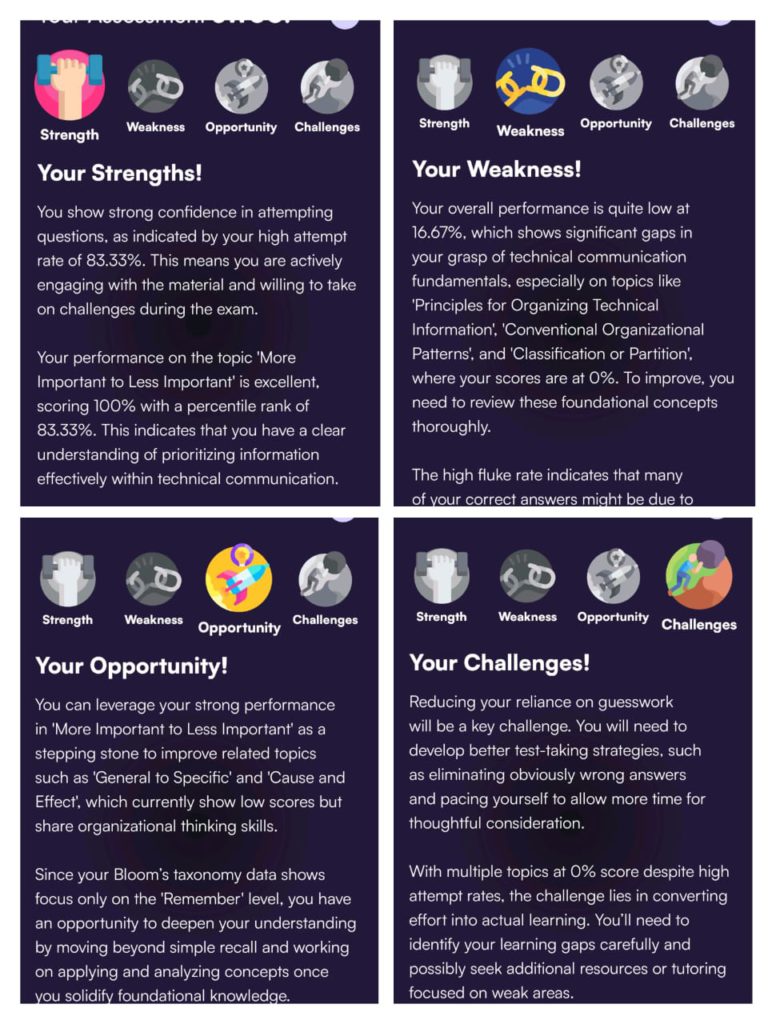
The student now knows: high engagement is good, but foundational gaps need attention. Specific areas to focus on are named with concrete next steps.
This is the difference between passive analytics (here’s what happened) and active guidance (here’s what to do about it). Between data that describes and data that directs.
AI as Teaching Assistant, Not Replacement
Edwisely’s design philosophy is simple: give faculty their time back so they can actually teach.
Real-time analytics means insights arrive while intervention matters. SWOC analysis translates patterns into action plans. The infrastructure makes visible what was hidden, actionable what was overwhelming.
The system handles what computers do well: processing 120 responses instantly, identifying statistical patterns, comparing performance across semesters, and flagging anomalies. You handle what only humans can: understanding festival week disrupted teaching, deciding whether to re-teach or provide materials, and knowing which students need encouragement versus challenge.
Faculty at partner institutions spend 60% less time on analysis while intervening earlier with more students. Not from working harder. From infrastructure that finally supports teaching instead of burdening it.
What AI-Powered Learning Analytics Make Possible
Imagine finishing an assessment and knowing, three minutes later, exactly which students need what help. And having time to provide it. You’re not spending Tuesday analyzing spreadsheets, but designing the demonstration that will make Topic 3 click for struggling students. You’re talking with Priya while the assessment is fresh. Explaining her reasoning is strong; she just needs to slow down. The conversation that changes her trajectory. You’re pairing students whose problem-solving is excellent, but execution is weak, with those who have the opposite pattern. Everybody improves. This isn’t technology replacing teaching. This is technology finally supporting it properly.
When AI handles what machines do well, you do what only you can do. Understand students. Design effective learning. Make judgment calls requiring wisdom, not just data. Build relationships that motivate real learning. So here’s the question: What would you do with ten extra hours per semester? What becomes possible when infrastructure works in your favor?
The technology exists. The question is whether we’ll use it to free teachers to teach, or bury them in more data they don’t have time to process.